
A GENEO perspective on standardised work, clarity, and operational excellence
Most organisations do not struggle because they lack standards. They struggle because their standards no longer serve the work. Across manufacturing and regulated industries, SOPs and work instructions have steadily grown longer, more complex, and more defensive. Written to satisfy governance, mitigate risk, and “cover all eventualities”, they have become documents that describe work rather than standards that enable it.
At GENEO, we see the consequences of this every day. Operators rely on experience rather than instructions. Supervisors translate documents into practical guidance on the fly. Improvement happens despite standards, not because of them.
This is where monozukuri quietly breaks down.
When documents replace understanding
Monozukuri depends on deep understanding of how work is done. It assumes that quality, safety, and efficiency are built into the process itself, not added through inspection or supervision. Documents, however, are a poor substitute for understanding. When standards are written primarily as documents, several things tend to happen. Language becomes abstract and technical, and critical details are buried among disclaimers and conditional statements. Instructions are written to protect the organisation rather than to guide the person doing the work. The document may be accurate, but it is no longer instructional, and as a result, the real standard lives elsewhere. It exists in people’s heads, in informal coaching, in workarounds developed over time. Variation increases, even though documentation grows. Risk is managed socially rather than systematically.
From a monozukuri perspective, this is a fundamental failure.

The unintended consequences of compliance-driven standards
Most SOPs do not become bloated by accident. They grow in response to real pressures: audits, incidents, regulatory findings, and organisational memory of what once went wrong. Each addition feels justified, with a sentence is added “just in case”, a step is broadened to cover multiple scenarios, so that over time, clarity is traded for coverage. The unintended consequence is that standards stop supporting execution.
Operators learn quickly which parts of the document matter and which can be ignored. New starters are overwhelmed. Training becomes an exercise in interpretation rather than learning. Leaders assume that because a document exists, the work is controlled. In reality, control has been replaced by hope. Monozukuri requires standards that make the right way of working obvious. When documents obscure rather than clarify, excellence in making things is left to individual judgement.
Why monozukuri demands simplicity, not completeness
One of the most common misconceptions about standards is that they must describe everything. In practice, the opposite is true. Effective standards focus attention on what matters most. They make critical steps explicit, and they highlight key points where quality, safety, or reliability can be lost. They explain why those points matter, so people can think rather than blindly comply. This is why traditional Lean approaches emphasise job breakdowns, standardised work, and visual clarity. They are not simplistic; they are precise. Monozukuri is not supported by comprehensive documents. It is supported by clear standards.
When organisations confuse completeness with control, they unintentionally undermine both.
The gap between written standards and real work
One of the clearest signals that standards have become documents is the gap between what is written and what actually happens. Leaders may be confident that work is standardised because documents are approved and version-controlled. Yet when they observe the process, they see variation everywhere, operators adapting steps, skiping sections, or relying on memory instead of instructions. This gap is not a behavioural problem; it is a system problem. People do not ignore standards out of defiance. They ignore them when standards do not help them do the job well. When documents are difficult to use at the point of work, people naturally revert to experience and peer support. Over time, the organisation becomes dependent on its most experienced people to compensate for weak standards. This creates fragility. When those people move on, variation and risk increase dramatically.
Monozukuri cannot be sustained under these conditions.
GENEO’s perspective: standards are a thinking tool, not a filing artefact
At GENEO, we approach standards from a different starting point. We do not ask how to document work; we ask how to make thinking visible. This distinction is subtle but critical. A document records decisions that have already been made. A standard, when designed properly, supports the act of making good decisions at the point of work. This is why GEN-OPS does not begin with SOPs. It begins with the job element.
By breaking work down into clear steps, identifying key points, and explicitly stating the reasons why those points matter, GEN-OPS forces a different kind of conversation. It shifts focus from “what should we write” to “what really matters here”. This approach exposes gaps quickly because if a team cannot explain why a step is critical, that risk has not been properly understood. If multiple variants exist, they are made explicit rather than hidden in footnotes or assumptions.
In this way, standards become a vehicle for learning rather than a static record.
Why element-level standards change everything
When standards are built at the element level, several things change simultaneously. First, clarity improves, as each element has a clear purpose and context, and operators can see exactly what is required and why. Second, reuse becomes possible. When an element is improved, that improvement can be applied everywhere it is used. Learning is no longer localised. Third, governance becomes simpler. Changes are made where they matter, reviewed appropriately, and versioned without rewriting entire documents. Most importantly, standards remain close to the work, so they evolve with the process instead of lagging behind it.
This is how monozukuri is protected in a dynamic, digital environment.
Documents freeze work; standards enable improvement
One of the most damaging effects of document-centric standards is how they inhibit improvement. When standards are long, complex documents, people are reluctant to change them. Improvement ideas accumulate in notebooks, spreadsheets, or separate systems. The standard itself remains static, even as reality evolves. GENEO’s view is that improvement must be inseparable from the standard. GEN-OPS is designed so that ideas, concerns, and problems are captured in context and linked directly to the relevant elements of work. Improvements follow the same governed process as any other change, ensuring traceability and control without discouraging participation. This creates a virtuous cycle. As standards improve, understanding deepens. As understanding deepens, people become more capable of identifying meaningful improvements.
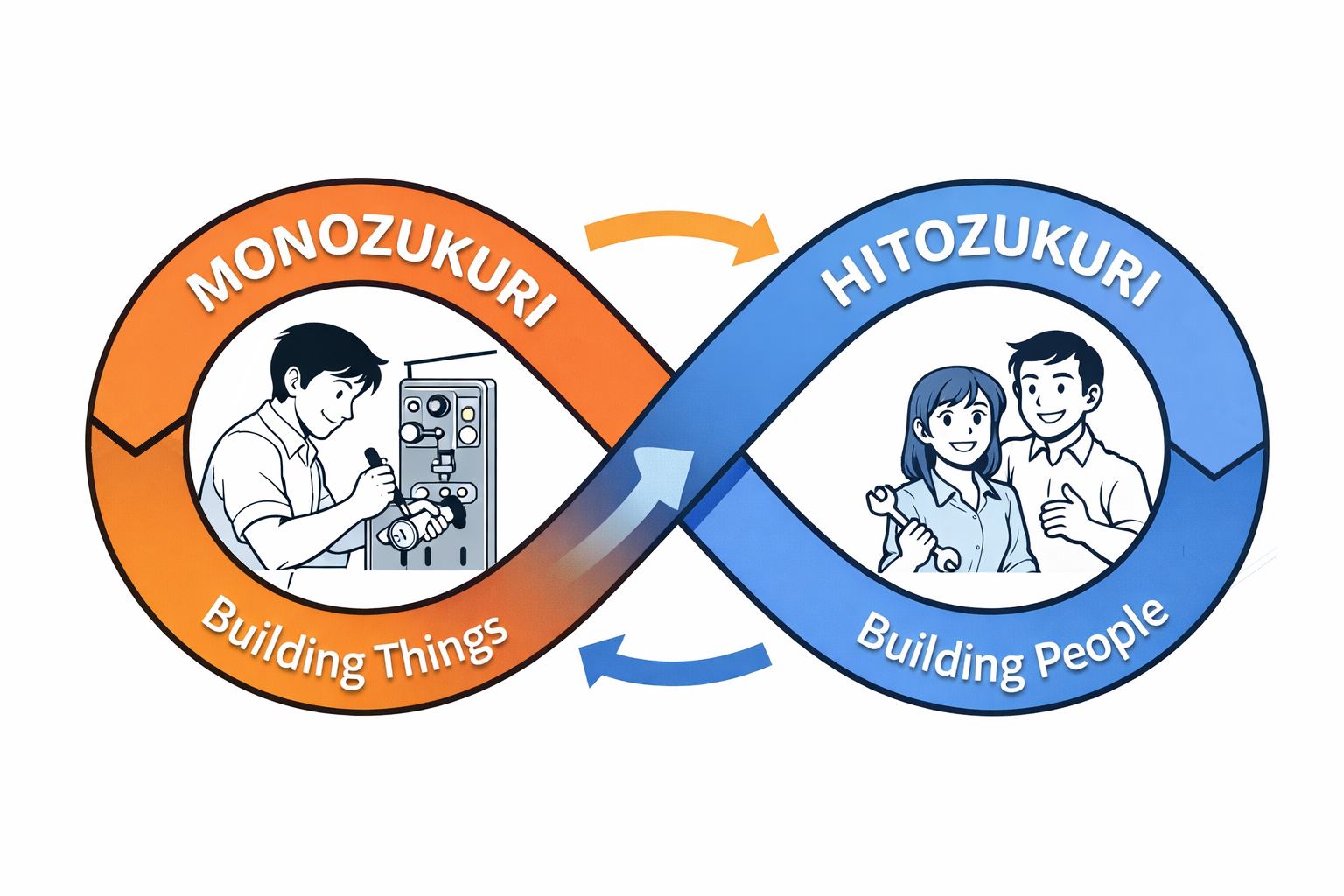
This is where monozukuri and hitozukuri reinforce each other.

Leadership visibility without bureaucratic burden
A common fear among leaders is that simplifying standards will reduce control. In practice, the opposite is true. Clear, element-level standards make it easier to see where work is stable and where it is not. They support meaningful process confirmation rather than checkbox audits, so leaders can engage with work directly, asking why steps exist and how risks are managed. This kind of visibility strengthens governance while reducing administrative burden. Control comes from clarity, not from volume. GEN-OPS was deliberately designed to make governance unavoidable but unobtrusive. Authorisation, versioning, and change control are built into the flow of work rather than layered on top of it.
This is governance that supports excellence instead of constraining it.
Reclaiming monozukuri in a regulated, digital world
Regulation and digitalisation are often seen as forces that inevitably push organisations toward heavier documentation. GENEO does not accept this as inevitable. Regulators expect control, traceability, and consistency. They do not require standards to be unreadable. In fact, clear standards that are demonstrably used, trained, and confirmed often stand up better to scrutiny than lengthy documents that exist only on paper. Digital systems, when designed with intent, can strengthen monozukuri rather than dilute it. They can make understanding explicit, improvements traceable, and learning permanent.
But only if standards are treated as living expressions of how work is done, not as documents to be managed.
From documents back to standards
Monozukuri fails when standards become documents because documents prioritise coverage over clarity and protection over learning. Excellence in making things cannot be sustained under those conditions. At GENEO, we believe the path forward is not to abandon standards, but to reclaim their purpose. Standards should make work easier to do well, safer to perform, and easier to improve. GEN-OPS exists to support exactly that.
In the next article in this series, we will explore how digital monozukuri works in practice — and how managing complexity upstream allows craftsmanship and clarity to flourish at the point of work.
Link to Part 3 – Digital Monozukuri: Making Quality Visible at the Element Level
Bob Newton is Customer Services Director at GENEO, supporting organisations to build brilliant standards that develop people, strengthen governance, and enable continuous improvement.