
A GENEO perspective on clarity, craftsmanship, and modern standardised work
Digital technology has promised many things to operations, amongst some but not limited to: greater visibility, faster feedback and better control. In some cases, these promises have been realised. In many others, technology has simply added another layer of abstraction between leaders and the work itself.
At GENEO, we believe this tension exists because digital tools are often applied at the wrong level. They focus on outcomes before processes are truly understood, and on aggregation before clarity exists at the point of work. Monozukuri, excellence in making things, cannot thrive under those conditions. It depends on deep, shared understanding of how work is actually done. If digital systems obscure that understanding, they weaken craftsmanship rather than strengthen it.
Digital monozukuri requires a different starting point.
Why visibility matters more than data
Most organisations today have no shortage of data. They track performance, defects, downtime, compliance, and training completion in extraordinary detail. Yet many leaders struggle to answer simple questions when they step onto the floor.
- What exactly is the right way to do this job?
- Where are the critical quality risks?
- Why does this step matter more than the others?
When those questions cannot be answered clearly, quality is not truly visible, it is inferred after the fact. We believe Monozukuri requires visibility at the level where work happens and by that we mean not just visibility of results, but visibility of intent. People must be able to see what matters, what must not vary, and why. This is where many digital systems fall short as it focuses on making performance visible while leaving the work itself opaque.
The problem with digitising documents
One of the most common mistakes organisations make is assuming that digitising SOPs is the same as digitising work. Documents are uploaded, versioned, and distributed electronically, and the organisation declares progress. In reality, very little has changed. The same long documents exist, now on screens instead of paper. The same assumptions about experience and interpretation remain. The same gaps between written standards and real work persist. Digital monozukuri is not achieved by moving documents online, rather it is achieved by making the work itself explicit.
GENEO’s starting point: the job element
At GENEO, our approach to digital monozukuri begins at the smallest meaningful unit of work: the job element. Rather than starting with an SOP, GEN-OPS asks a more fundamental question: what are the individual elements that make up this work, and what must be true for each of them to be done safely and correctly Each element is defined through clear steps, key points, and explicit reasons why those points matter. This structure does something deceptively powerful. It forces quality, safety, and risk to be articulated rather than assumed. If a team cannot explain why a step matters, that is not a documentation problem, it is a knowledge gap. GEN-OPS makes those gaps visible.
This is the essence of digital monozukuri: using technology to surface understanding, not to hide it.

Making quality visible, not implicit
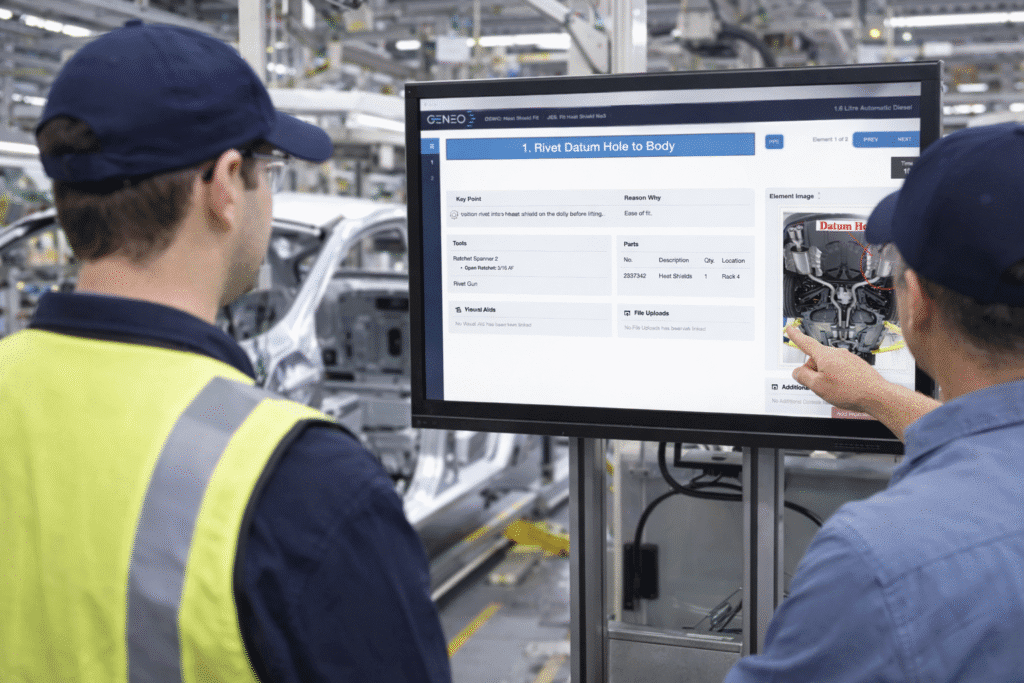
In many organisations, quality lives in people’s heads. Experienced operators know which steps are critical, which shortcuts are dangerous, and which variations are acceptable. Newer team members learn through observation and correction rather than through clear standards. This model does not scale. When quality is embedded at the element level, it becomes visible to everyone. Key points are not buried in paragraphs of text. Reasons why are not left to interpretation. Risk controls are part of the work, not an appendix. GEN-OPS is designed to make this visibility unavoidable. By structuring standards around elements, it ensures that critical quality and safety considerations are explicitly linked to the steps where they matter.
Quality is no longer something that is “checked later”. It is designed into how work is done.
Managing complexity without overwhelming the work
Modern operations are inherently complex. Product variants, derivatives, regulatory requirements, and changing demand introduce layers of variation that cannot be ignored. The mistake many organisations make is pushing this complexity down to the frontline. Instructions grow longer. Exceptions multiply. Operators are expected to remember which version applies today.
GENEO takes a different approach. In GEN-OPS, complexity is managed upstream, through structured handling of variants, derivatives, and change. The system absorbs this complexity so that what is presented at the point of work remains clear and stable. From the operator’s perspective, the standard does not become more complicated just because the business is. From a monozukuri perspective, this is critical. Craftsmanship requires focus. It cannot survive constant cognitive overload. Digital monozukuri is not about simplifying the business, it is about protecting the work from unnecessary complexity.
The power of element-level reuse
One of the quiet strengths of element-level standards is reuse. When work is broken down into meaningful elements, those elements can be shared across processes, lines, and even sites. When an improvement is made to an element, it does not remain local. It propagates everywhere that element is used. Learning scales without rewriting entire SOPs. This is how digital systems can genuinely support continuous improvement rather than slow it down. Done well, improvement becomes cumulative instead of fragmented.
GEN-OPS was deliberately designed to make this possible. Elements are not locked inside documents. They are living components of how work is defined and improved.
From static documents to a digital twin of work
When element-level standards, variants, and improvements are combined, something powerful emerges: a digital representation of how work is actually done. This is not a simulation. It is a living model, grounded in real standards, real processes, and real people. Leaders gain the ability to see where work is stable and where it is not. They can understand the impact of change before it is introduced. They can see how demand shifts affect workload and balance. More importantly, this visibility is rooted in the work itself, not just in metrics.
This is what GENEO means by a digital twin of work — a system that reflects reality closely enough to support better decisions.
Why digital monozukuri strengthens hitozukuri
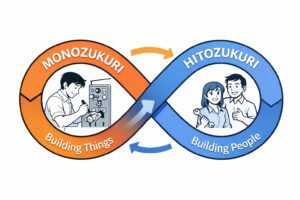
Although this article focuses on monozukuri, the impact on hitozukuri is unavoidable. When quality and intent are visible at the element level, people learn faster. They do not just memorise steps; they understand why those steps exist. This supports judgement and shifts the compliance culture to one of continuous improvement. When standards are clear and stable, leaders can coach effectively. Process confirmation becomes a meaningful conversation rather than a checklist exercise. Learning is grounded in real work, not abstractions. Digital monozukuri creates the conditions for hitozukuri to flourish.
Technology as an enabler of craftsmanship
There is a persistent fear in operations that digital systems will deskill work or replace human judgement. This fear is understandable, particularly when technology is used to automate decisions without transparency. GENEO’s view is different. We believe technology should make good judgement easier, not remove it. By making quality visible, by clarifying intent, and by supporting continuous improvement at the element level, digital systems can actually elevate craftsmanship. They allow organisations to capture and share the thinking of their best people, rather than relying on them as single points of failure.
This is digital monozukuri in its truest sense.
Reframing digital transformation
Digital transformation in operations should not begin with dashboards or data models. It should begin with a commitment to understanding work deeply and expressing that understanding clearly. Monozukuri cannot be digitised at the document level. It must be digitised at the level where work is done, step by step, element by element. At GENEO, we believe that when digital systems are built on this foundation, they strengthen both quality and people. GEN-OPS exists to make that possible.
In the next article in this series, we will turn our attention to hitozukuri, and explore why developing people is not a training problem, but a standards problem.
Link to Part 4 – Hitozukuri Is Not Training: How Standards Develop Thinking
Bob Newton is Customer Services Director at GENEO, supporting organisations to build brilliant standards that develop people, strengthen governance, and enable continuous improvement.